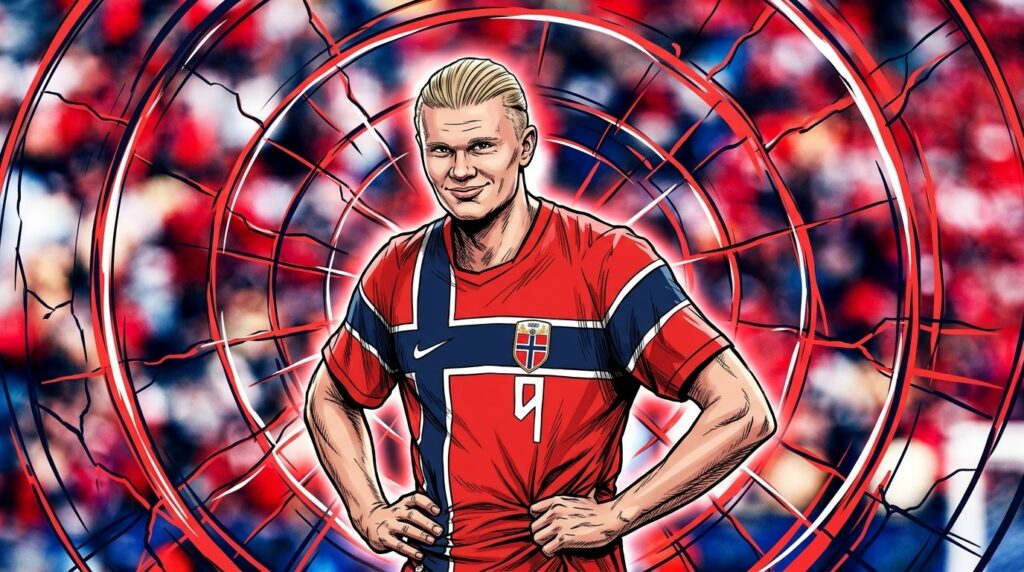
Erling Haaland scored a header in the 79th minute and a low strike in the 90th to eliminate Brazil 2-1, send Norway to their first-ever World Cup quarterfinal, and, in the process, blow up two weeks of tournament coverage that had already moved on from him. The guy scored 16 goals in eight qualifying matches. Norway went unbeaten across that stretch, outscoring a group that included Italy by 37 total goals. And the American sports media’s prevailing label for this team, right up until Sunday night at MetLife, was “dark horse.”
That framing deserves scrutiny, because it tells you more about how coverage gets assembled than about the actual quality of Norway’s squad.
The Dark Horse Label Was Always Wrong
“Dark horse” is a specific thing. It means an unknown quantity — a team with credible upset potential but limited evidence of elite performance. Norway in 2026 was not that. Haaland had scored in 14 consecutive international appearances, 27 goals across that streak. His qualifying numbers — 16 goals in 8 matches — were not a curiosity. They were a warning. Fox Sports ran a pre-tournament piece listing Norway among teams that “can actually make a run” — filed under “dark horses,” which is exactly the problem. That’s the coverage apparatus acknowledging the threat while simultaneously refusing to price it in at the top of the bracket conversation.
The structural reason this happens is predictable: broadcast prep, segment bookings, and promotional calendars all anchor around the same eight or ten programs. Brazil. France. Argentina. England. Those are the teams whose narratives get pre-produced, whose star players get the feature treatment before a ball is kicked. Haaland got the feature treatment at Manchester City. For Norway, he got “dark horse.” When Sports Illustrated ran a piece titled “Why Everyone Is Falling in Love With Erling Haaland” after the Brazil result, the headline contained the answer to its own question: after. Everyone fell in love after. The work was done before.
Nobody’s TV Deal Was Built for This
The US rights for this World Cup — Fox Sports and Telemundo — were negotiated in February 2015. Haaland was 14. Norway had not qualified for a World Cup since 1998. The deals locked in before any of this was imaginable, which is fine; that’s how rights deals work. What isn’t fine is when the coverage itself fails to adjust as actual evidence accumulates over the following decade.
The group stage averaged 5.1 million US viewers across Fox, FS1, and Tubi — up 92 percent from 2022. Brazil’s group match against Morocco drew 10 million, the most-watched non-USMNT group stage game. Norway’s group games didn’t register in those top-line numbers. The commercial logic ran toward Brazil. And now Brazil is home, Neymar has retired, and the quarterfinal slot that every broadcaster assumed would be England vs. Brazil is instead England vs. Norway on July 11 at Hard Rock Stadium in Miami. That matchup was not on anyone’s promotional calendar.
What Actually Happened at MetLife
Haaland is tied with Mbappe and Messi for the Golden Boot at seven goals, and the tournament has a new center of gravity. His brace against Brazil wasn’t fortune — it was the same pattern that produced 16 qualifying goals and 27 straight international goals. The header off an Andreas Schjelderup cross in the 79th was technically precise. The low strike in the 90th was the kind of finish that ends arguments about whether Norway deserved to be here.
Neymar’s penalty in stoppage time — his final touch for Brazil before announcing international retirement — added the emotional weight. He made his Brazil debut at MetLife Stadium 16 years ago and retired at the same venue, finishing with 80 international goals and a tournament exit to a team that everyone kept calling a dark horse. There’s a version of that night that’s just sad. The version where the coverage had been paying attention, it’s also a corrective.
Norway plays England July 11. Haaland has seven World Cup goals. The English are aware.