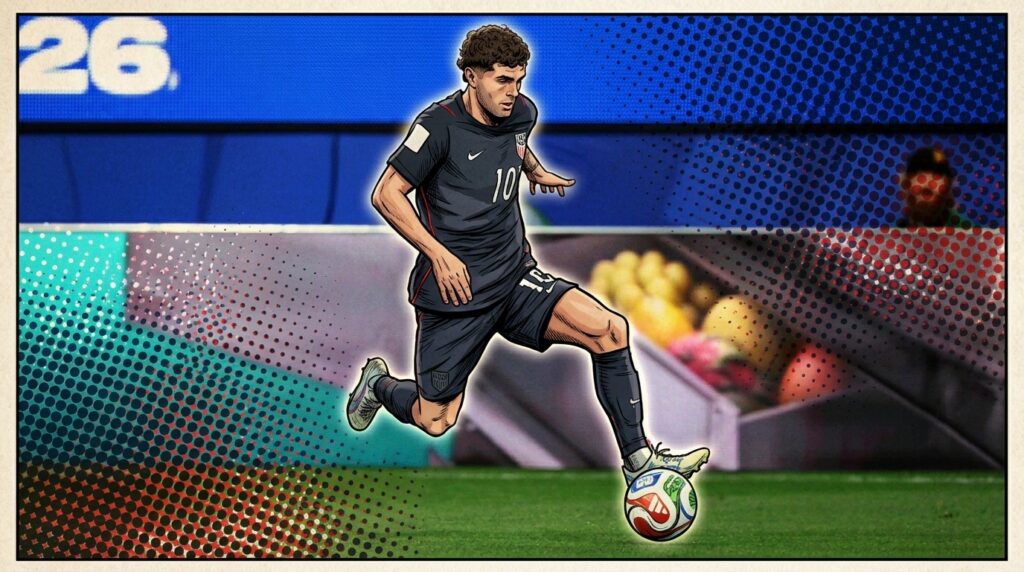
France and Spain kick off at AT&T Stadium this afternoon, 3 PM Eastern, on Bastille Day, with a place in the World Cup final at stake. It is exactly the kind of match that broadcast rights deals are built around — European heavyweights, a packed house in Arlington, a US audience that has spent the last three weeks discovering or rediscovering why this sport consumes the rest of the planet. FOX will air it. John Strong on play-by-play, Stu Holden on analysis. It should be a showcase. Whether it actually will be is a different question, because FOX has spent most of this tournament demonstrating that holding the rights and understanding the moment are entirely separate things.
Start with Day One. The opening ceremony at Estadio Azteca — Shakira, Burna Boy, J Balvin, Tyla, the first World Cup on American soil kicking off in Mexico City — aired in full on Telemundo. FOX, which paid $485 million for exclusive US English-language rights, showed its studio desk in an empty SoFi Stadium instead. Rebecca Lowe, Alexi Lalas, Thierry Henry, and Zlatan Ibrahimovic discussing the US team while Shakira performed for a global audience of hundreds of millions. FOX eventually aired a delayed package with the on-air admission, “It’s a little late, but better late than never.” Shakira never appeared on FOX at all.
That sequence — Spanish-language competitor does it right, English-language rights-holder does something incomprehensible — has played out on loop ever since.
Then came the hydration break problem, which wasn’t subtle. FIFA has a broadcast rule: during scheduled hydration breaks, networks must return to the match at least 30 seconds before play resumes. During the very first hydration break of the entire tournament, Mexico vs. South Africa, FOX ran commercials past the window, returning to the match approximately 10 seconds after play had resumed. Viewers missed live match action. FIFA reviewed it, accepted FOX’s explanation that it was a misreading of the referee’s signal, and issued no punishment. But the sequence was already documented in real time by reporters covering the match:
FOX subsequently pivoted from full-screen ads during hydration breaks to a split-screen format — commercials in the larger window, match in a smaller inset. Whether you find that an improvement or just a differently calibrated version of the same problem probably depends on your tolerance for watching live World Cup play in a corner of your television. What isn’t in dispute is the financial logic. Sportico reported that FOX booked nearly $200 million in bonus ad sales from hydration breaks during the group stage alone — roughly 260 additional seconds of inventory per match, with early-round slots selling at around $200,000 per 30 seconds and USMNT slots reaching $750,000. The $485 million rights fee — well below the estimated $1 to $1.5 billion market value — may itself have been structured to maximize exactly this kind of break-time monetization. Every other revenue stream — traditional ad buys, subscriber fees, sponsorships — is profit on top of that.
Which makes the incompetence so much harder to explain. FOX is not struggling to break even here. The deal that looks undersized compared to the $1 to $1.5 billion that industry analysts estimated as the true market value — itself a function of the below-market rights extension FIFA granted FOX in 2014 to avoid litigation over the Qatar schedule shift — has turned into a windfall. The opening ceremony decision was not a cost-cutting measure. Somebody at FOX simply did not think it was worth showing.
The criticism has come from expected and unexpected places. John Skipper, who ran ESPN through the 2006, 2010, and 2014 World Cups, went on Pablo Torre’s podcast and delivered the kind of backhanded compliment that lands harder than a direct attack: FOX’s coverage is “the second-greatest production of the World Cup ever.” Former US international Eric Wynalda publicly called Lalas “unwatchable.” The Guardian described Lalas’s punditry as “trollish, hyperventilating garbage.” FOX Sports CEO Eric Shanks has defended Lalas as a cornerstone of the network’s identity, which means either Shanks believes it or he’s decided the heat isn’t worth addressing. Neither answer is reassuring.
Netflix, Disney, and YouTube are all reportedly interested in the 2030 and 2034 cycle, which analysts expect to fetch $1.5 to $2 billion in competitive bidding — the process FOX bypassed entirely in 2014.
France vs. Spain this afternoon is the best match of the tournament so far. FOX has been handed the most compelling stage it will ever occupy. The question heading into the semifinal is the same one it’s been all month: will the network treat this as the event it is, or as ad inventory with 90 minutes of soccer attached?