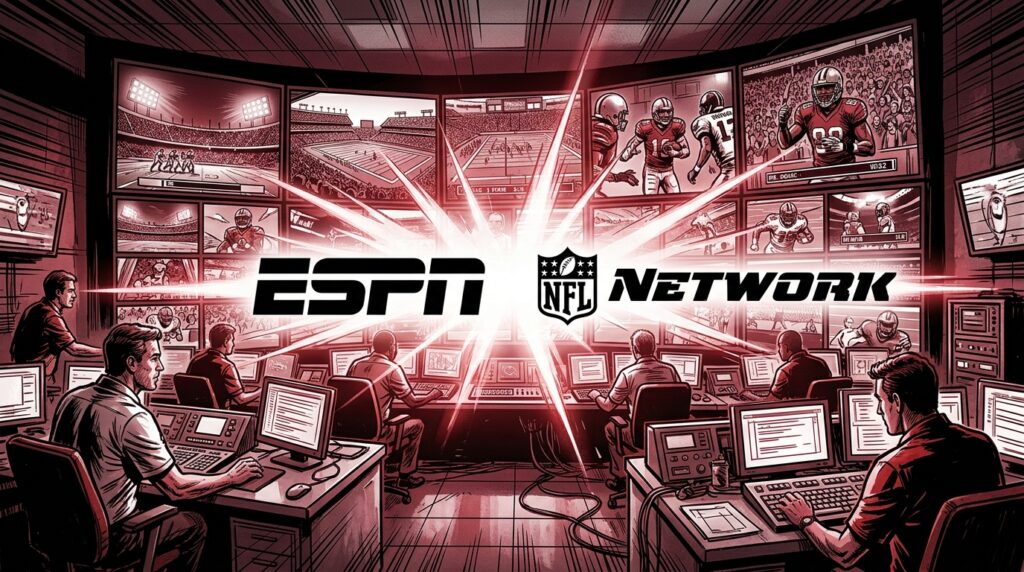
April 1, 2026: ESPN officially takes operational control of NFL Network after a $3 billion acquisition that closed in February. May 1, 2026: NFL Network and RedZone go dark on Comcast Xfinity. Thirty days. That’s how long it took for the deal that was supposed to unify NFL content for fans to immediately strip it from millions of Comcast subscribers.
Call it efficient, at least.
How a $3 Billion Deal Became a Blackout in Six Weeks
The public dispute is a familiar he-said-she-said. Comcast says Disney/ESPN demanded double the carriage fees it had been paying the NFL directly — and that ESPN’s distribution demands would force customers who don’t watch NFL Network to pay for it anyway. ESPN countered with a statement saying it offered to keep the channels live during negotiations and Comcast turned that down. Both companies are telling a version of the truth that is maximally flattering to their own balance sheets, which is all you really need to know.
What makes this moment different from every prior NFL Network carriage fight is the 2023 precedent. Three years ago, Comcast and the NFL had almost the exact same dispute — and it resolved in roughly 24 hours because Roger Goodell personally picked up the phone and called Comcast CEO Brian Roberts. The NFL backed down to approximately 15 cents per subscriber. Done. Crisis over. The NFL owned the channel, the NFL could make a unilateral business decision to hold the line or fold, and the NFL folded fast because keeping fans happy was the institutional priority.
That option is structurally gone now. ESPN doesn’t have a 23-year relationship with Brian Roberts. More importantly, ESPN paid $3 billion for this asset and owns it inside a company that is trying to juice subscriber counts for its new direct-to-consumer service (priced up to $29.99/month). Goodell can’t call Roberts on behalf of a division he just sold. He IS the conflict of interest — the NFL now holds a 10% equity stake in ESPN, so the commissioner of the league has a financial incentive for ESPN to extract maximum carriage fees. The 24-hour safety valve evaporated the moment the acquisition closed.
This Is What Consolidation Actually Looks Like for Fans
The deal announcement in August 2025 came with the customary raft of corporate optimism. ESPN Chairman Jimmy Pitaro called it “an exciting day for sports fans” and promised a “premier destination for football.” Goodell said the acquisition would provide “more NFL football for more fans in new and innovative ways.” Thirty days into ESPN’s operational control, Comcast subscribers have less NFL Network than they had before the deal — which is genuinely an innovative outcome, just not the intended use of that word.
This isn’t a side effect of consolidation. It’s the mechanism. When ESPN gains leverage — buying the NFL’s own channel, securing the league as a minority equity partner — it uses that leverage to extract higher carriage fees from distributors, and distributors either pay up and pass the cost to subscribers, or walk. There is no third option. The fan who watches NFL Network on Xfinity cable has exactly zero leverage in this negotiation and no good alternative short of subscribing to another service. A Sportico analysis cited by Sen. Warren put the maximum cost of accessing all 272 NFL regular-season games at $935 per season across cable, Peacock, Paramount+, Amazon, and YouTube TV. That number is going in one direction.
Senator Elizabeth Warren made her position clear:
Warren and Rep. Pat Ryan have both flagged the broader pattern of “streamflation” — sports content consolidating behind paywalls while politicians who enabled the structural conditions through regulatory inaction act surprised. The Sports Broadcasting Act of 1961 gave the NFL antitrust protection to bundle and sell its TV rights as a package; what that protection actually built over 60 years is the exact market structure fans are stuck inside today. The league used that protection to accumulate distribution leverage, then sold that leverage to Disney, which is now wielding it against a cable company that will eventually either pay or lose subscribers to a streaming service that costs — coincidentally — $29.99 a month.
At training camp, one side blinks. They always do, because NFL content is still the most valuable sports programming in the country and both ESPN and Comcast know it. The 2023 Disney–Charter/Spectrum blackout lasted 11 days before football season forced a resolution. This dispute started post-NFL Draft in the dead zone of the sports calendar, which means neither side is sweating a hard deadline yet. Fans will sit in the dark until a deadline matters to one of the corporations arguing over who gets their money.
The NFL designed this when it sold. Goodell is now a 10% equity partner in the entity pricing his own fans out of the channel he called essential for 20 years. If you wanted to find a sentence that captures the current state of professional sports as a business, that one does the job without trying very hard.