Twelve games. Fifteen days. One calf strain. That’s all it took to watch the most expensive roster construction in Mets history dissolve into the worst record in baseball.
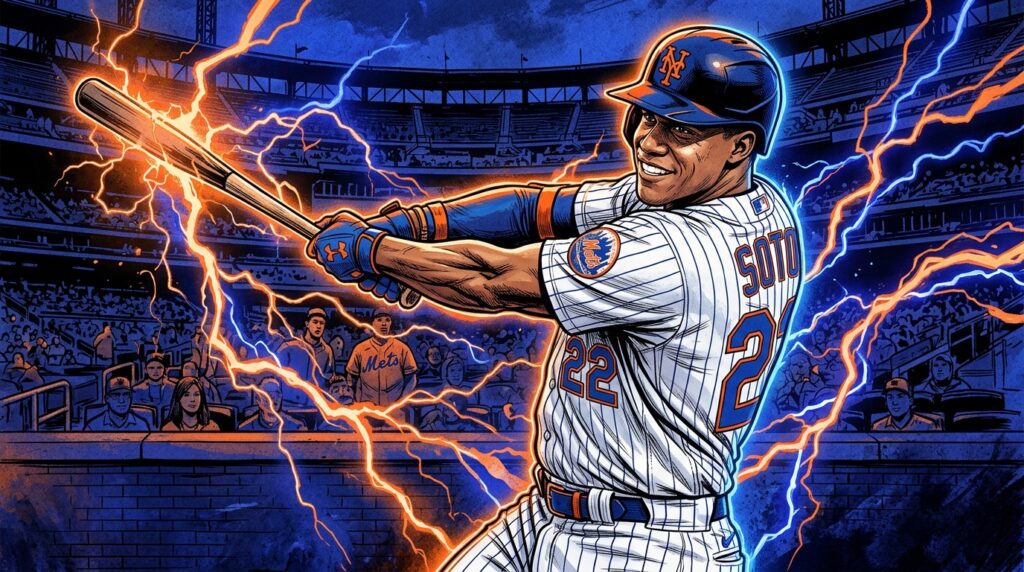
Juan Soto strained his right calf on April 3, stepped off the field, and within the week the New York Mets — $364 million payroll, second only to the Dodgers — had started a 12-game losing streak. They scored 1.83 runs per game during that stretch. Every other MLB team averaged at least 3. Their hitters batted .161 with runners in scoring position; with two outs and RISP, they hit .094, which is the kind of number you’d expect from a pitcher’s spot. Per ESPN’s breakdown of the losing streak, the Mets scored more than two runs in just three of those 12 losses.
This is not a story about bad luck. It is a story about a specific design choice and its predictable consequences.
The Mets’ front office entered this offseason with one priority: sign Juan Soto. At $765 million over 15 years, they got their man — and then surrounded him with a supporting cast carrying red flags that, in retrospect, were hard to miss. Bo Bichette’s bat speed had fallen to the 12th percentile. Marcus Semien, 35 years old, was already posting below-average offensive numbers in 2025 and arrived in 2026 with his bat speed sitting at the 8th percentile, his strikeout rate at multi-year highs. Jorge Polanco was slotted at first base despite never having played a professional inning there. The Mets had missed on Kyle Tucker — a legitimate two-way building block — and appeared to respond with a series of reactive, upside-chasing signings rather than addressing the roster’s structural depth.
With Soto, the Mets were averaging 4.38 runs per game. Without him, that number cratered to 2.67. That gap — nearly two runs per game — is the entire argument. You cannot build a functional offense where one player’s presence or absence creates a 40 percent swing in run production and expect the whole thing to hold.
On April 15, eight games into the losing streak and sitting at 7-12, Steve Cohen posted this on X:
“Nobody likes to lose but I saw some ‘green shoots tonight.’ On offense, Lindor had two hits including a home run. Bichette got a double hitting it to left field as opposed to recently being right field prone. Benge got a solid hit. Soto started his running progression today. Semien hit a shot that might have been a home run on a warmer night. Finally, Nolan McLean pitched an outstanding game going 7 innings. Hang in there fans, we will turn this around!”
Bichette hit the ball to left field. That was a green shoot. Fans on Reddit were not moved: “Yikes, we are celebrating ‘almost hits’. This team has scored 1 run in 29 innings… some of these guys look washed.” Cohen’s optimism was sincere, probably. It was also the ownership equivalent of a doctor calling a flat EKG “a great opportunity to appreciate the silence.”
The broader structural failure here isn’t just about lineup construction. Edwin Diaz, Pete Alonso, Brandon Nimmo — the franchise anchors of recent memory — are gone, replaced by a constellation of aging veterans and injury-prone acquisitions assembled around one cornerstone. That’s not how the Dodgers built their dynasty, and the Mets know it; as FanGraphs noted in their mid-April salvage analysis, the team’s playoff odds dropped from 79.5 percent preseason to 41.3 percent by the end of the streak. The Dodgers combine spending with depth, player development infrastructure, and players who fit a larger system. The Mets bought the star and hoped the system would arrive on its own.
It didn’t.
When Soto returned on April 22 — going 1-for-3 with a walk in a 3-2 win over the Twins that ended the skid — he was asked whether he’d reached out to his teammates during the 12-game spiral. “No, not at all,” he said, per SNY. “They’ve been on the road most of the time, so I haven’t talked to them.” That quote is not a character assassination. It is, however, a useful data point about the kind of gravitational center the Mets actually have in that clubhouse — the guy the whole plan depends on, watching from home, not calling.
Soto is back. The streak ended. The Mets then lost two straight to the Rockies, falling to 9-19. And when Soto returned on April 22, Francisco Lindor suffered a calf strain in the same game — a detail so on-brand it barely needed comment. Luke Weaver put it plainly after the streak-ending win: “It’s not very often we have such a talented team where everything just doesn’t click in the right way. It’s quite an impossible feat, but we made it possible.”
That’s exactly right. And it was possible because the plan was always fragile — a single injury away from collapse, which is exactly what happened. The calf strain didn’t reveal something new about this roster. It just made the design flaw impossible to ignore.